Male brotherhood and an outlaw Motorcycle Club made in South Italy
To the land I had to leave.
Introduction
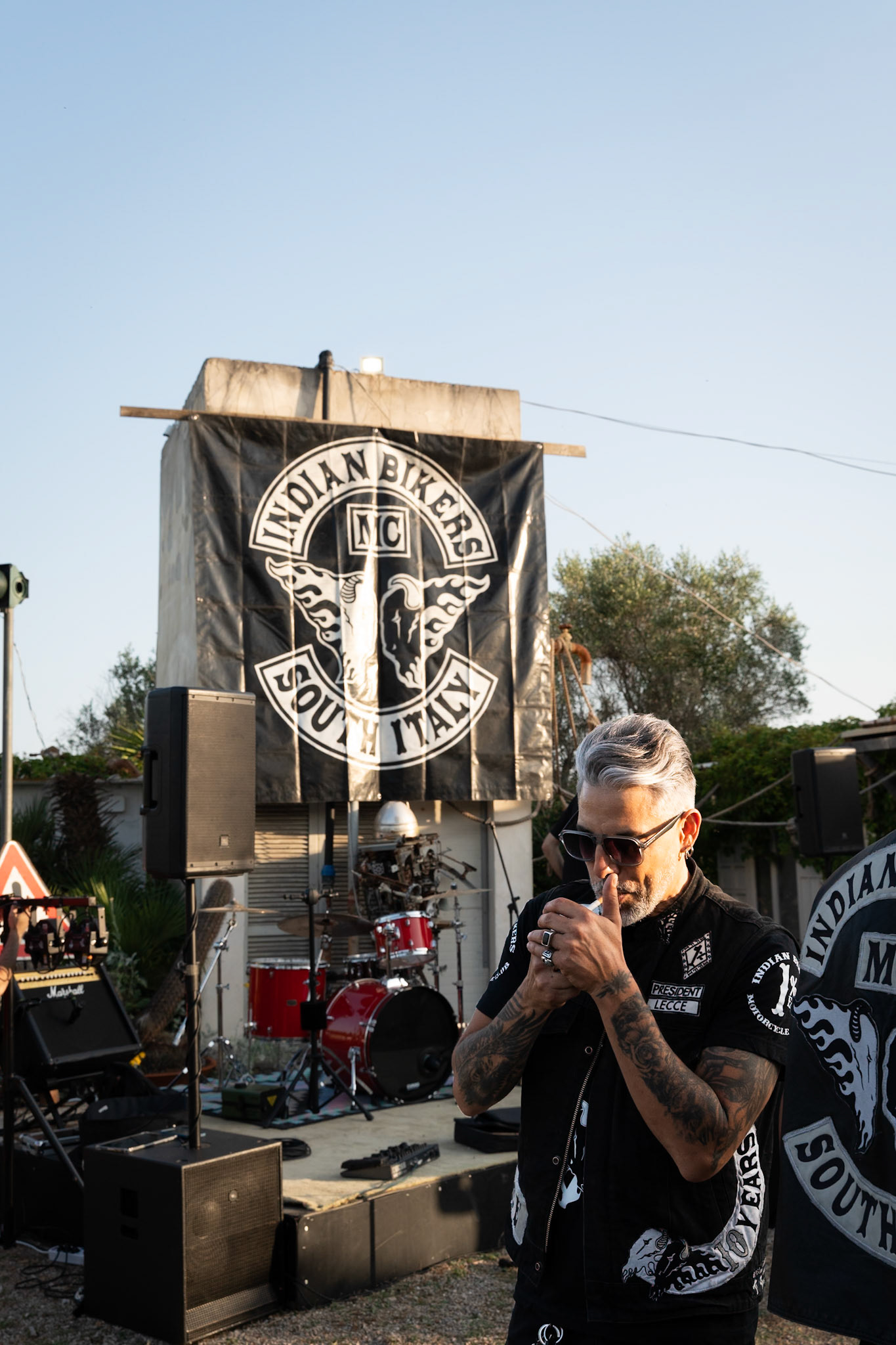
This project is the result of 2 and a half years of fieldwork research in South Italy. During this period, I followed the Indian Bikers Motorcycle Club (from now on “IBMC” or just “Club”) in its movements, events, gatherings, dinners and campings. The images you are about to see are related to the last 6 months of research, period during which I was given official consent by the MC founder to photograph and publish the Club members and insignia, previous his review and approval.
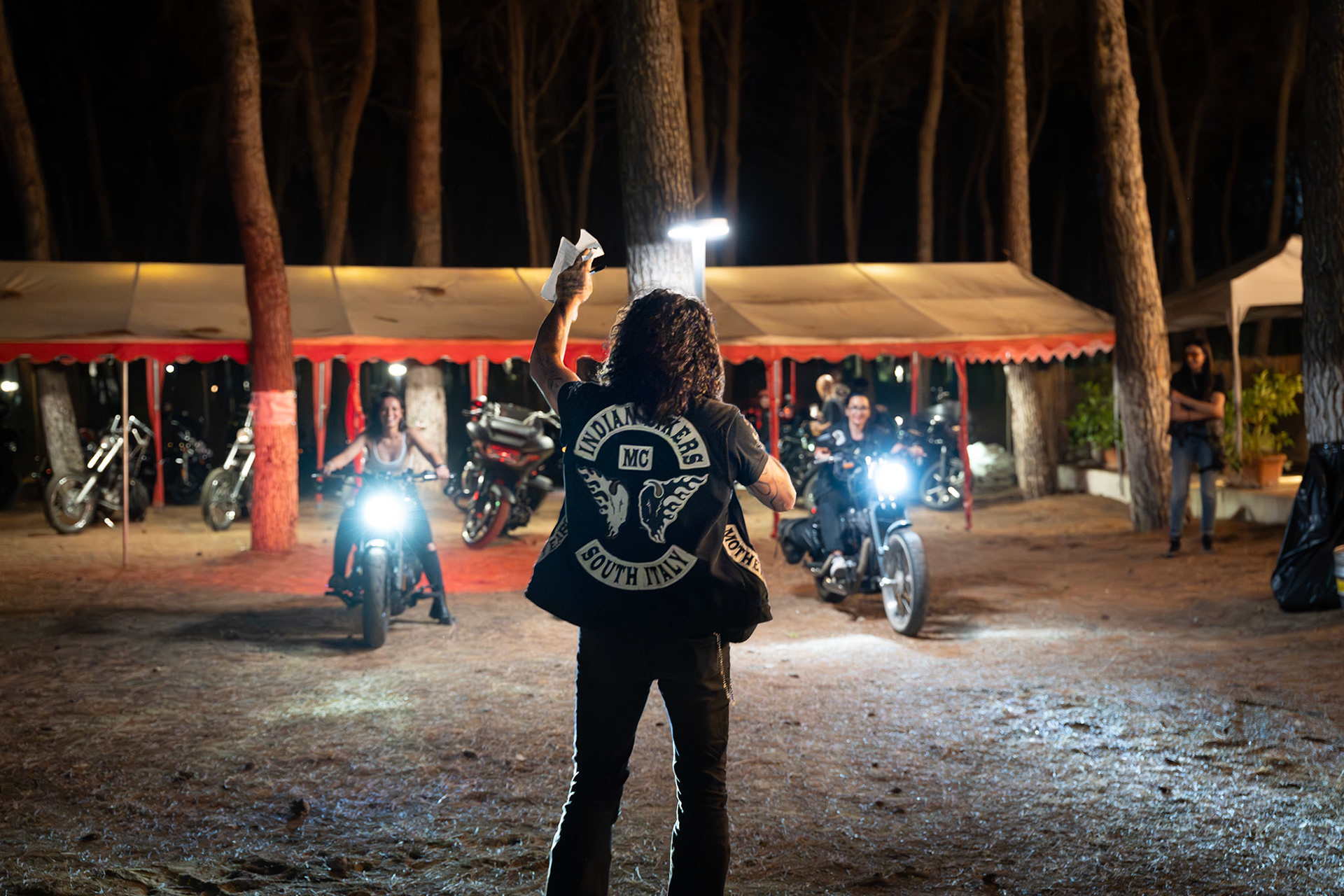
It was a late night of July 2023 when a man attending a live music event in a biker bar named Madness in the outskirts of Lecce, Italy, caught my attention. He was a thirty-something years old fit guy, dressed in all black, wearing a leather gilet with some stylish black & white insignia on its back. He was standing on the same spot, not even drinking or smoking, for at least half an hour. An oddity, I thought, for a bikers bar.
I had already become a proud, self-taught motorcyclist myself not long before then. I had been enthusiastically scouting around different biking communities of my city with my vintage Kawasaki ER-5, tasting different flavours of what riding a motorbike means for different people (you’d be surprised), been on several group rides and attended a bunch of live events organised by and for the community. I’m sure if you asked me back then whether I had seen my fair share of groups and organisations, I would have replied positively, and confidently so. But outside that bar looking at that all-black guy, I had in front of me a different beast.
I had already become a proud, self-taught motorcyclist myself not long before then. I had been enthusiastically scouting around different biking communities of my city with my vintage Kawasaki ER-5, tasting different flavours of what riding a motorbike means for different people (you’d be surprised), been on several group rides and attended a bunch of live events organised by and for the community. I’m sure if you asked me back then whether I had seen my fair share of groups and organisations, I would have replied positively, and confidently so. But outside that bar looking at that all-black guy, I had in front of me a different beast.
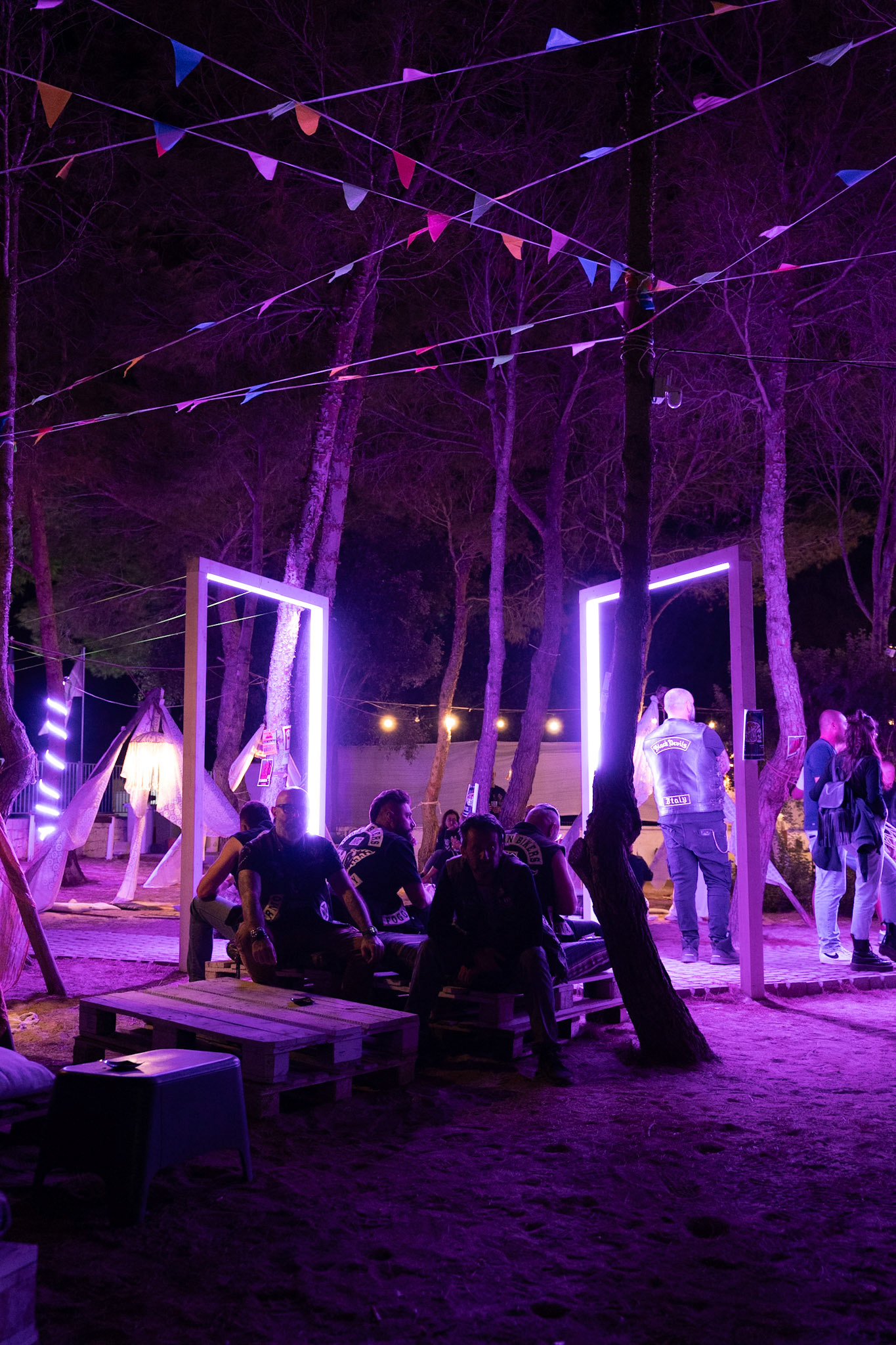
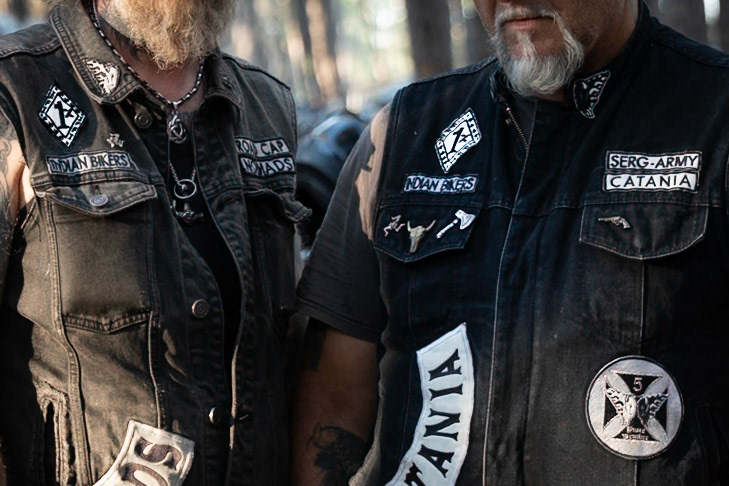
Upon my approach and introduction as an anthropologist, the biker respectfully declines to answer my naive, introductory questions regarding the nature of the emblem he was wearing and the Club he was representing. He instead points me towards a comrade who, rather than a leather gilet, had a jeans one but with more patches both on its front and back. Of all, one of these captured my attention the most: on his left collarbone, a rectangular patch declaimed “VICE PRES.” and, right under it, another identical read “LECCE”.
It was that night that I met Mirko and Luca: I understood that they were to be my ethnographic “informants” for my next visual project. What I did not know yet, is that we were also meant to share the road and become friends.
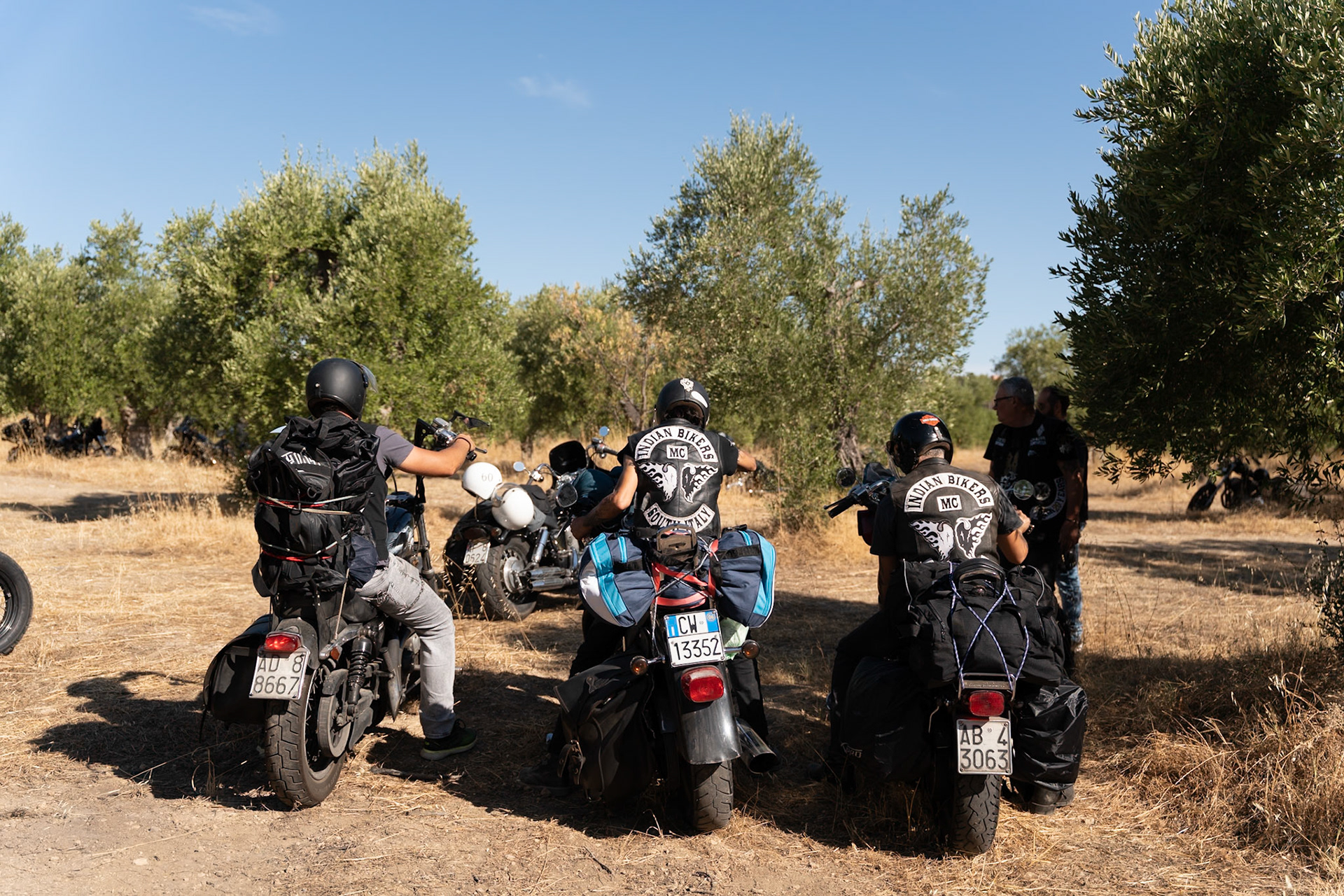
This is the story of my personal experience living and travelling with the Indian Bikers Motorcycle Club.
Proud Southerners and brigands. They do not accept to expand towards the North. Whoever wants to join em North of Rome can only be a Nomad.
They don’t want any bullshit or interference. The “external society” is crumbling apart. Theirs is an oasis of support and brotherhood.
“We don’t talk about ourselves with the outside world”. I can go hang out with em at [redacted] on Tuesdays, but I cannot stick my nose in.
With these concise sentences I summarised before hitting the bed the most important feelings of the night. I remember clearly the sensation of being onto something. Even after graduating and choosing not to stay in the academic world, I kept pursuing my own long term, economically unsustainable visual ethnographic projects around South Italy. I was drawn by fringe communities and alternative lifestyles in an Italian region where tradition and old conventions always seem to dictate our identities and self-narration, both to the world but also to ourselves.
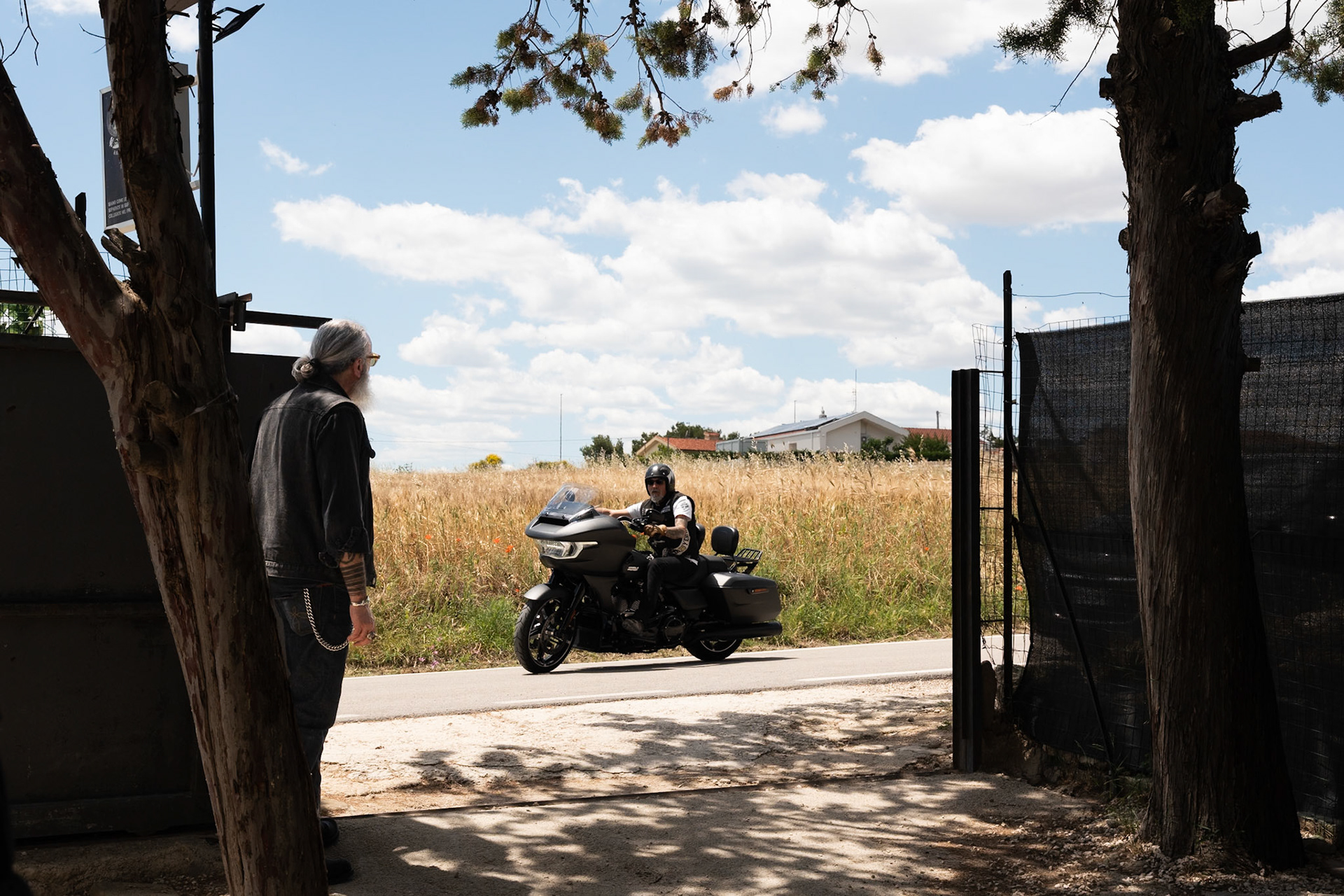
Ten days later I found myself at their clubhouse, where Mirko heard my motorcycle engine from afar and came to open the gate for me. The location is deep in the flatland countryside of Salento. That night at the biker bar, after Luca told me what he could about their Motorcycle Club, I came clean about who I am and what I want: a visual anthropologist always interested to get to know and to shoot an interesting community like theirs. Luca gave me his business card and the rest was in my journal. I had texted him a couple of more times since that night at the bikers bar, with no luck for a visit. But there I was now, crossing that gate to get to know them, and most likely to pitch my project about them to a boss that I did not meet yet.
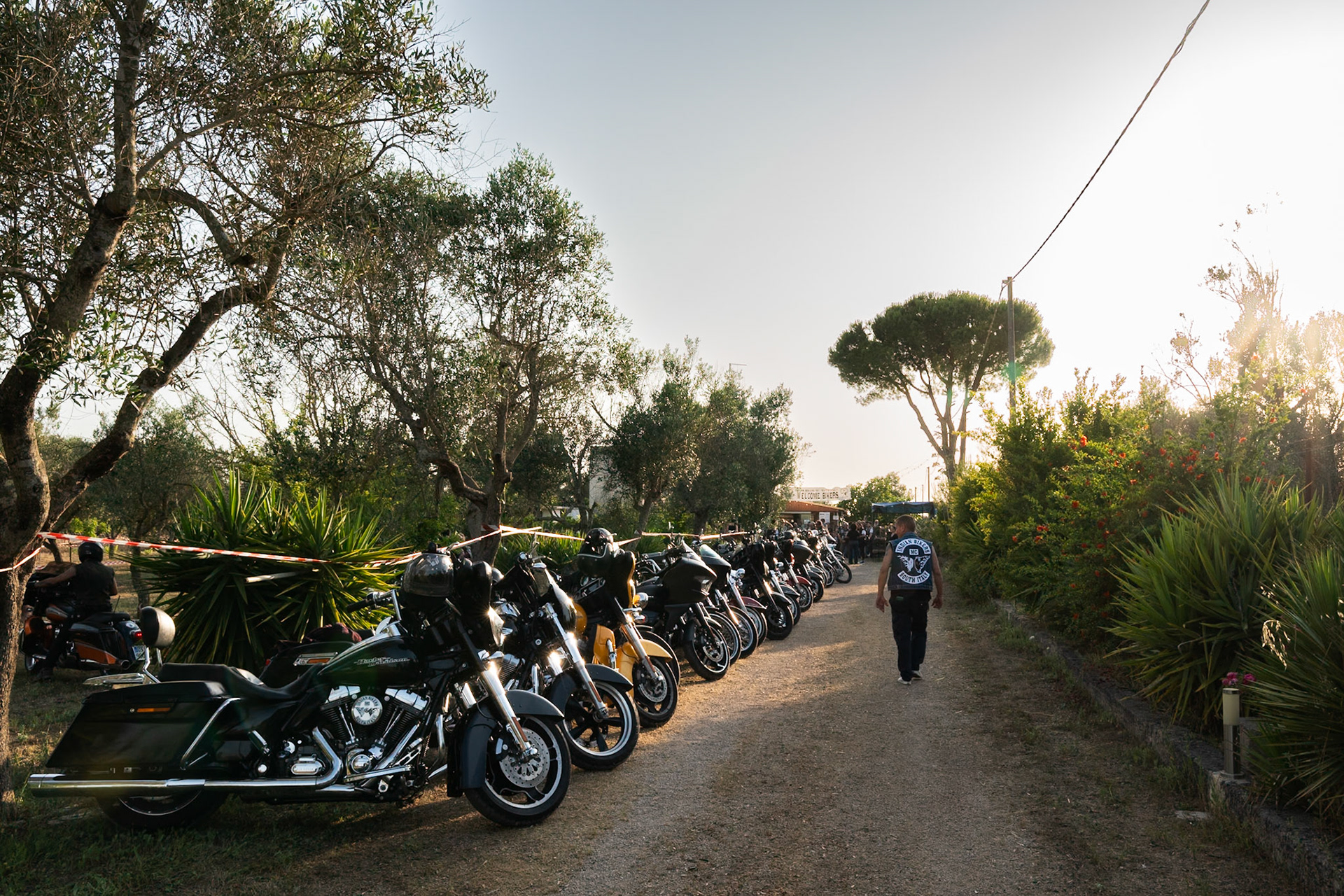
After having locked the gate back, Mirko comes to help me back up the motorcycle parallel to the couple other Harley-Davidsons that were already there. Back facing the fence, front towards the gravel alley I came from. I remember it being a big, relatively empty front yard, and I found this fixation in parallel-parking the only three or four motorcycles that were there that night, mine comprehended, a bit quirky. To my yet ignorant eye, it looked like both an aesthetically pleasing way of managing space and motorcycles and also a way to say “we’re always ready to scram” as the front wheel had to face the road. Surely an unusual effort of tidiness for the average Italian rider (or driver, for that matter) that I never saw on any other occasion. I did not know this yet, but being helped/helping other bikers backing up by pushing the front rack of the bikes while the rider steers it in perfect parallel position to the others was to become a recurrent ritual to see and perform myself in any gathering of the MC world.
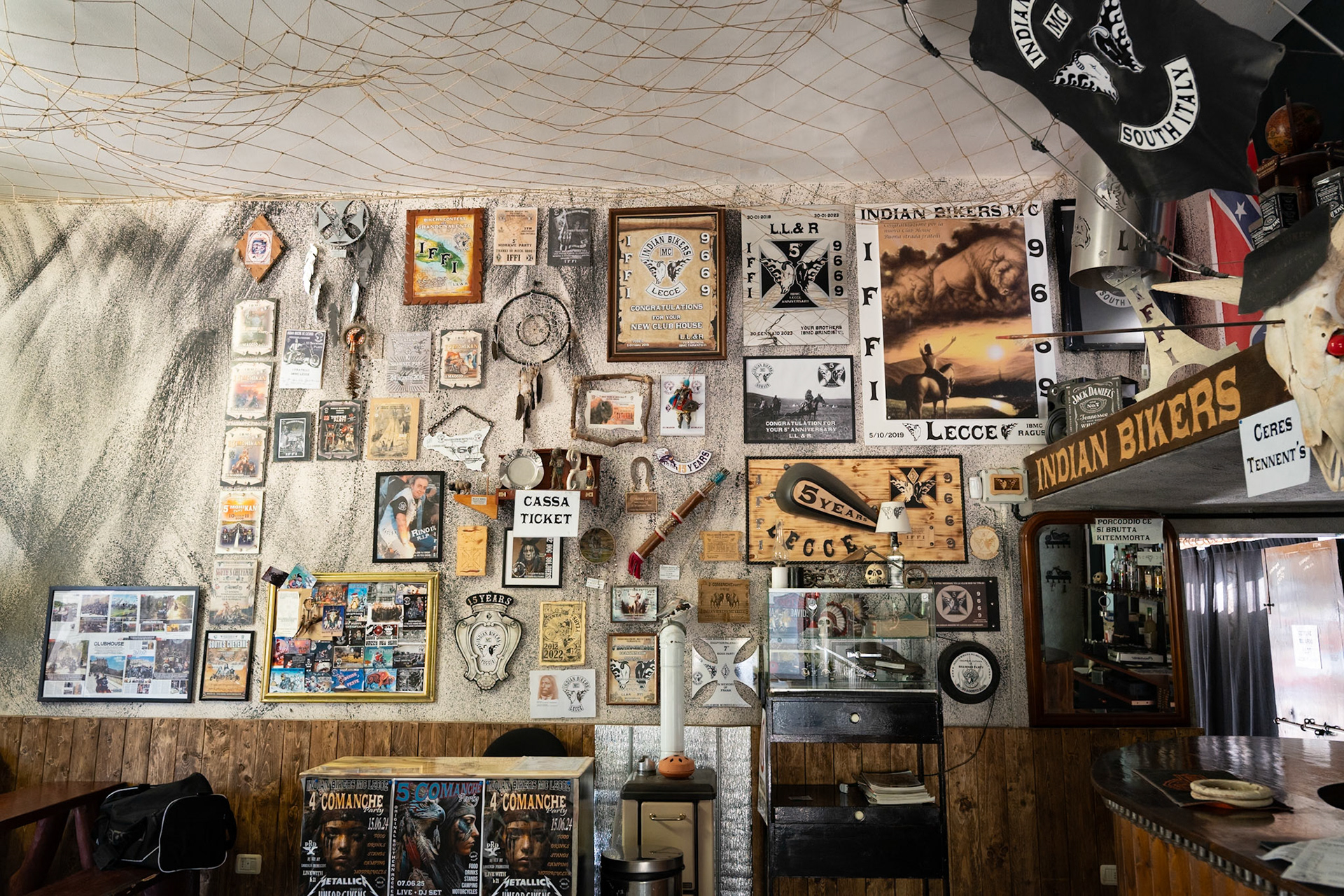
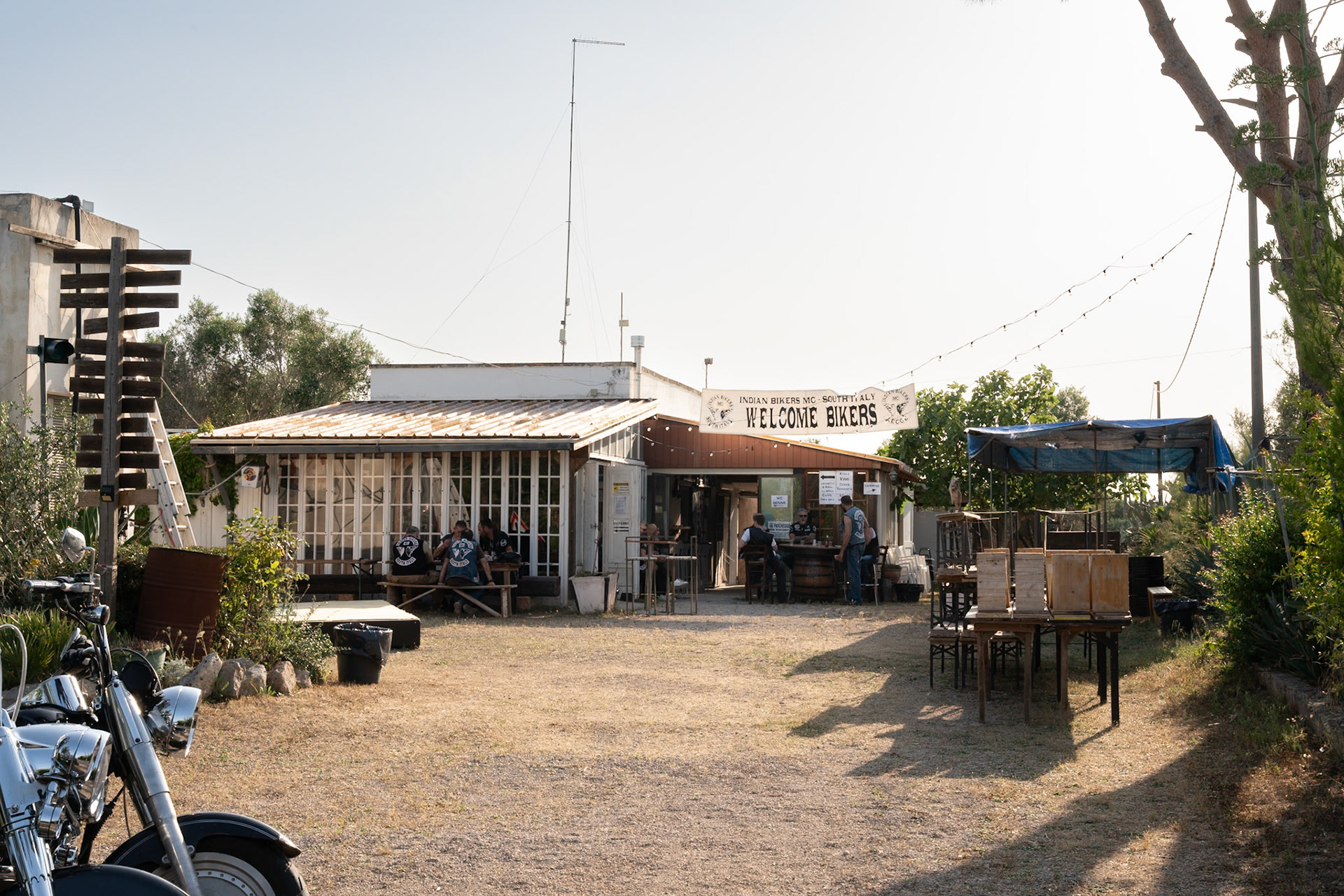
Finally, I was there. Lost, about 30 minutes of riding far from the province capital (Lecce), in a patch of private countryside reachable only crossing a masseria (local farm keep) and taking a secondary dirt path behind it, riding by a Marian wayside chapel. If it wasn’t for the navigation from the phone I had attached to my bike handlebar, I would have never found it. Once off the bike, I can admire the Lecce chapter’s clubhouse: a rural house with a seemingly huge dirt parking lot with olive trees as parking markers. Inside, all sorts of biker paraphernalia, scraps of magazine articles, photographs, events and nights posters testified to a long activity. Finally, the handmade wooden bar coronates the center of the property.
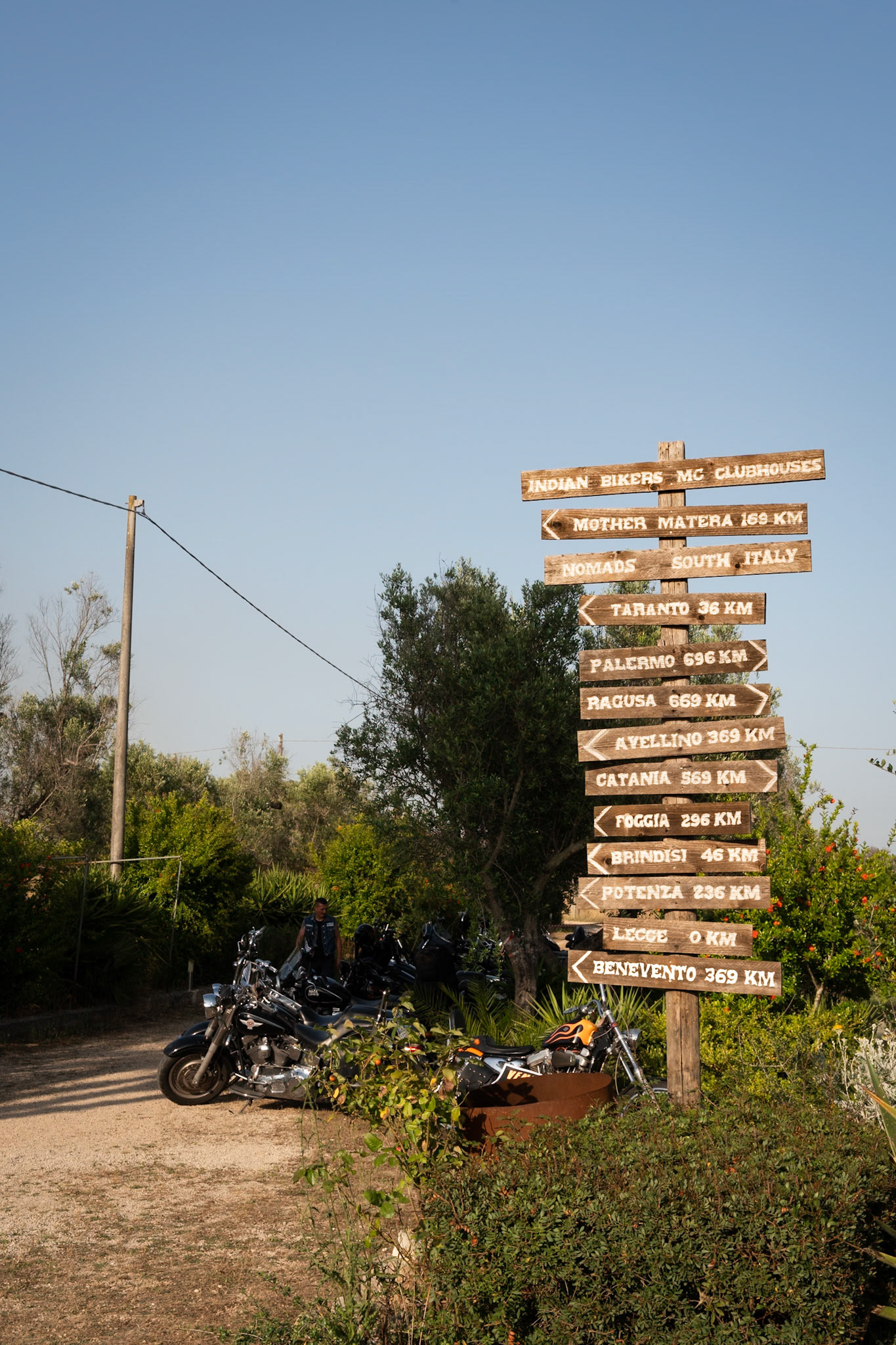
It was one of the hottest days I can remember. It was 43°C in the shade, and I rode towards a flaming sunset. My Kawasaki engine did not seem to be suffering, but I certainly did. Mirko tells me that Luca (the VP I was in contact with) and the President, whom I had not met yet, were locked “in Church”, which means in assembly in a physically separated room. In the meantime he wanted to present to me another member, who I would only later understand to be still a Prospect. To do that he brought me to the kitchen on the back of the building. Johnny was a skinny guy, instantly friendly, but always serious in his tasks and duties. He was busy cleaning some freshly fished shrimps by himself. As a matter of fact, he explained to me he was a proud fisherman.
After a while, the meeting hall door unlocks and Luca steps out of it. He tells Mirko and me we can now join em in. Before I could enter though, he stops me at the entrance and asks me to leave my phone at the bar. I comply. It was at that very moment while walking through the church threshold without my ever-present mobile that I realised that, when they told me they want no nosiness, they were serious.
A bit of History
In cultural anthropology, when we study human communities that identify themselves in a very hard core of shared values and sometimes also adopt exclusive lifestyle practices, it’s not hard to also find a “founding myth” from which it all started. A true, but often adorned historical fact that acted as a divide between a generic before and a very much defined after. In the MC community, this role has been given to the (in)famous 1947 Hollister Riot. Understanding what Hollister means to the MC world is crucial if we want to go beyond the “folklore entertainment” of seeing convoys of Harley-Davidson motorcyclists wearing the same insignia on the highway or at a bar, and actually understand why and how those insignia are so important in the first place.
Ever since the 1930s, the American Motorcycle Association (AMA) had organised yearly “Gypsy Tours” in the little 4.000-people Californian town of Hollister, where attendants could engage in recreational motorcycling activities (hill climbs, tug-of-war etc.). During the World War II period, the AMA suspended the gathering for the years in which the United States and its men were engaged in both the European and the Pacific theaters. Especially for the European one, Harley-Davidson had built a total of around 90.000 motorcycles for the troops. Many soldiers not only saw for the first time in their lives, but learnt to ride a Harley-Davidson exactly in this period, while enlisted in a painful and years-long war effort.
When the war ended, thousands of veterans returned home, bringing along trauma and having a hard time just functioning again in a civilian life they struggled to recognise as fair. Comradery and valor seemed to smash daily against a society with increasingly higher inequalities. American life seemed to be utterly indifferent to values of the likes of loyalty and brotherhood. A code that on the killing fields of Europe or on Iwo Jima helped these men survive or, at least, allowed them to die with grace and purpose. Back in “civil” life, living or dying became hollow concepts which the vast majority of people barely talked or cared about.
In the battlefield, a fast-paced life was slowed down by true burden sharing and reciprocal support. Back home, a slow-paced life was senselessly accelerated by the meaninglessness of job routines and the unforgivable shallowness of interpersonal relationships. A world of meaning was crumbling apart, as fast as unnoticed by just everybody else.
But back at home they bought their trusted Army Harleys back for dirt cheap. Mainly white veterans, they started riding around in packs, sharing the road and a sentiment of brotherhood they left at the front. Back then, there still weren’t any Motorcycle Clubs as we know them nowadays, at least not officially. The only institution that was officially recognised nationally was the AMA (American Motorcycle Association), and it was the AMA that took care of organising and sponsoring nationwide gatherings of motorcyclists. The most important of which was the Gypsy Tour, a three-day event that before the war used to gather around a thousand motorcyclists for fun games, hill climbs and tug-of-wars in and around the 4.500 people town of Hollister, California. Having been suspended for the entire duration of the war, the Gypsy Tour came back to the motorcyclists’ calendars in 1947. It was then that the Motorcycle Clubs myth began.
In 1947, Hollister, Ca. saw no less than an invasion of bikers. For the Gypsy Tour, four times the usual amount of motorcyclists came to town, equalling Hollister’s own residential population in just a few days. It’s therefore easy to imagine how a general climate of lawlessness, drunkenness, scuffles broke out. The 7 man strong local police force had to be backed up by State Police to be able to drive the gathering out of town.
The Life Magazine cover photo of a drunken man laying onto a Harley, bottle in hand and surrounded by empty bottles on the street, framed and packaged the perfect moral scandal for the wider American public: “Cyclist's Holiday: He and Friends Terrorize Town” the title spelled.
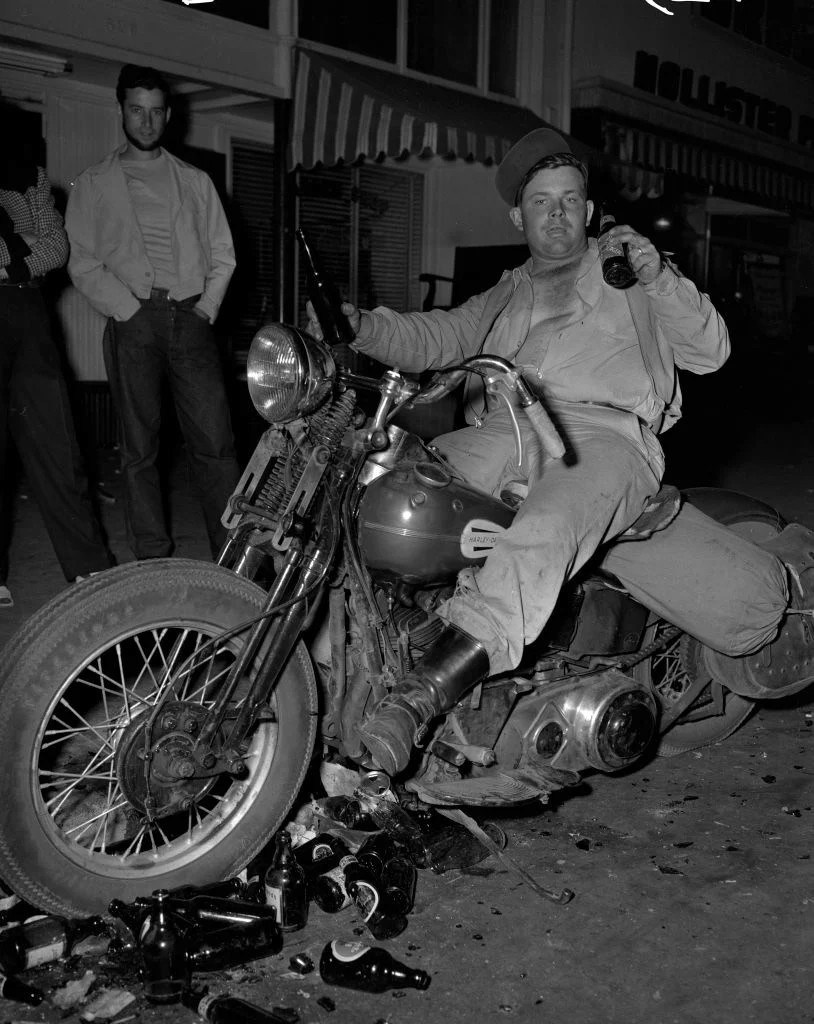
The outrage from the so-called civil society was then so pressing that, as the tradition goes, the AMA felt compelled to release a statement to distance itself from what happened in Hollister. In it, it supposedly declared that 99% of its members and its surrogate Motorcycle Clubs were law-abiding, and that it was only the small remaining percentage of riders that had tarnished the otherwise spotless reputation of the AMA.
This statement alone was in no small part responsible for the making of Motorcycle Clubs history as we know it today. It was not long after it that many of those rebel veteran white male bikers would feel more represented by, say, the newborn Outlaws MC rather than just any AMA surrogate MC.
They had seized that 1% stigma and had proudly started wearing it on with defiance.
They were proud “one percenters”.
_________________________
After a bit of small talk Mauro, the President, presents himself and the group with pride. He tells me that he listened to his VP and the respectful way in which I presented myself and what we’ve talked about at the Madness. Before moving forward, he asks me to tell him directly about what I would wanna do, about what is my business and how I carry it.
There were a variety of themes that had been touched that night with both Mauro and Luca between my curious back and forth of naive questions, namely:
1. There is an abyss between the state-recognised Motorcycle Clubs and what the 1947 Hollister riots baptised as 1% Motorcycle Clubs. In brief, with the former, you can just pay your membership and not show up weekly or worse, for planned rides. It is just a way for Harley, Royal Enfield, BMW, Moto Guzzi or Kawasaki owners to gather around with same-brand motorcycles (and rigorously on sunny summer Sundays) to have a chat about their motorcycles and maybe ride a bit. You’re hardly required any effort in presence, commitment or saddle time when entering a state-recognised Club, both in Italy and around the world.
On the contrary, 1% MCs are not recognised by the state and its members call themselves brothers for one reason. Becoming a full patched member can often require years of Prospect and a proven commitment to serve within the Club. They have a clear and recognised hierarchy and, if you don’t manage to be present to the better part of your weekly meetings, rides and events, you’re out. The concepts of membership and brotherhood meld in a fusion of high commitment and shared values that makes this bike life unmistakably and inherently different from any other. You have to hard-earn what you want to become and thus, when you do become a full member, you’re embodying the brotherhood.
2. Within the Indian Bikers MC, the spirit is proudly and overwhelmingly Meridionalist, which I learnt with years it has an important double meaning. Firstly, it means it is a Club where the focus is on the complicated yet fascinating concept of Southern Italian-ness and the ancient values it carries, especially in a pre-unitarian framing of the South of Italy as a prosperous, dignified society later subjugated by the Northern occupation that the history books called Unification.
Secondly and most importantly as I would later learn to discern, this Southernness is brought forwards in antithesis with what the MC world has nowadays become “in the North”, where the North refers to both the North of Italy and, more in general, the way most of the biggest, world-wide present MCs have often sacrificed the old school values of brotherhood and motorcycling to the altar of sheer political and economical power.
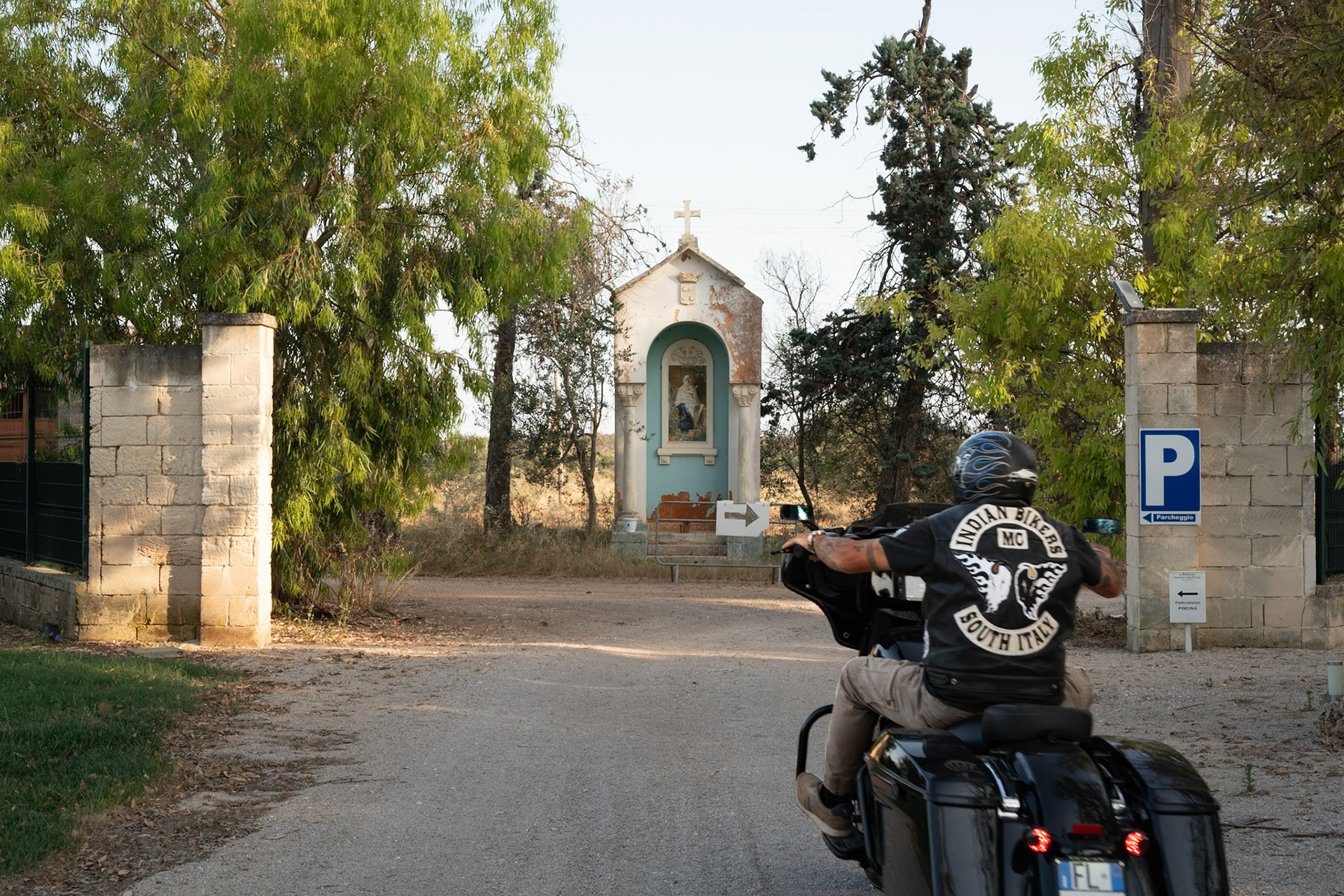
Moreover, the “Indian” bit of their name does not refer in any way to the famous American motorcycle brand (akin to Harley-Davidson), nor to the famous expression of the Jesuit Miguel Navarro that, upon coming to bring the Catholic Reform to the South of Italy, defined our socio-religious landscape as “the Indies of over here”. It might indeed be fitting to the IBMC defiance towards centralised institutions and untameable nature, but Indian does not refer to any of this. In particular, it evokes the parallel that Rosario, the founder and President of the Mother Matera Chapter, draws between the martial repression of banditry in southern Italy and that which the United States of America reserved for the Native Nations on their continent. In an almost poetic way, Rosario chose to unite these two tragedies which were happening in the very same years and the epics of which were only divided by an ocean. “Indian means: born here. We were born here”, as he likes to say.
3. From what I could understand both from this first encounter with the Lecce chapter and my parallel studies on the matter, Motorcycle Clubs like Indian Bikers, Hell’s Angels, Mongols, Bandidos etc. can be defined as “one percenter MCs” or “outlaw MCs” alternatively. It is interesting how the “outlaw” label is much more internally used rather than externally given.
While it is based on the fact that the State does not recognise the MC’s integrity as a whole - nor the MCs actively seek this acknowledgement - its use is more owed to a willingness from the MCs to position themselves as far as possible from State-registered clubs, and to signal how they do not need approval from any bureaucratic apparatus to exist and operate. The exactness of the “outlaw” label they give themselves, while not being technical, is historical and “mythological”: every time it is pronounced, it re-establishes the wild, untamed nature of their roots.

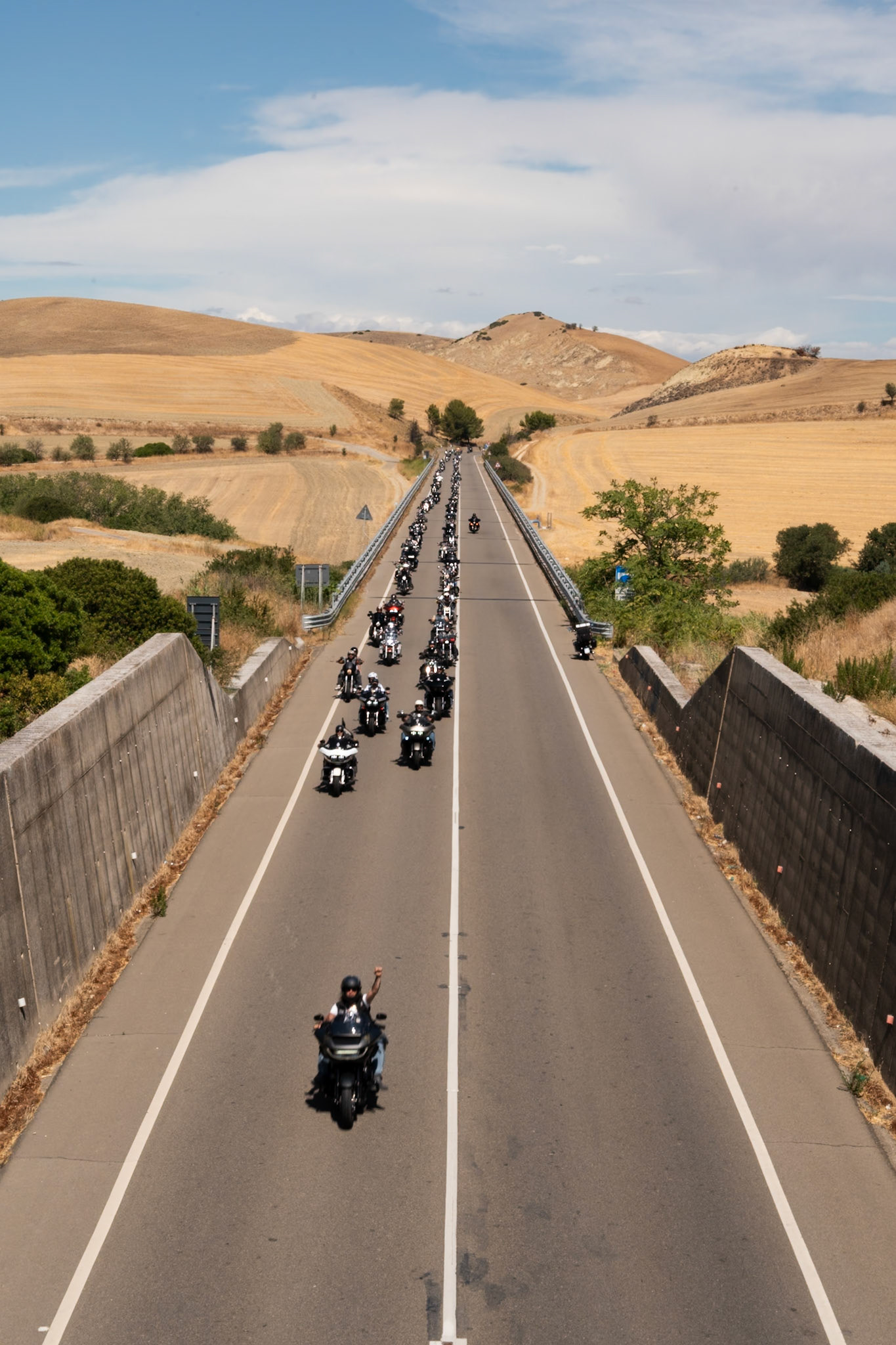
4. Even more interestingly, these fierce roots actually give way to a very disciplined code of conduct inside the MCs. Both on the ground and on the saddle. Tasks and responsibilities are meticulously identified and assigned to prospects, members and higher ranks. Convoys, transfers, honorary delegations and public runs are subject to the strictest discipline I have ever encountered when riding in packs. Absolute zero technology-reliance (no interphones, no in-helmet bluetooth or mesh systems, not even use of direction lights) combined with precise rank-assigned roles of coordinating the formation, using only evident arm gestures and hand signs.
From this perspective, it looked like the most retrograde and at the same time efficient method of travelling by motorcycle. It is like watching the exact negative of state-acknowledged Clubs. Even if State-recognised, these Clubs have hardly any internal structure, trust or let alone brotherhood amongst their loose memberships. And in their runs there is no discipline, formation or accountability. Group rides quickly escalate to dangerous races between single riders (been there). On the other hand, as a biker myself I must admit that riding in a formation of Indian Bikers for the years they have allowed me to join them in their seasonal movements felt like a true privilege. There might be no intercom communications nor direction lights, but every single movement the formation undertakes progressively shakes the convoy from head to tail and is well communicated by the Road Captain riding ahead. Every instruction of his is passed down the convoy “analogically” through hand gestures. Other roles (like the Enforcer) are in charge of making sure the Road Captain’s commands are executed in safety by all riders - like for example when he occupies the fast lane to stop any incoming vehicles and allow the formation to surpass, say, a truck on a highway.
From this perspective, it looked like the most retrograde and at the same time efficient method of travelling by motorcycle. It is like watching the exact negative of state-acknowledged Clubs. Even if State-recognised, these Clubs have hardly any internal structure, trust or let alone brotherhood amongst their loose memberships. And in their runs there is no discipline, formation or accountability. Group rides quickly escalate to dangerous races between single riders (been there). On the other hand, as a biker myself I must admit that riding in a formation of Indian Bikers for the years they have allowed me to join them in their seasonal movements felt like a true privilege. There might be no intercom communications nor direction lights, but every single movement the formation undertakes progressively shakes the convoy from head to tail and is well communicated by the Road Captain riding ahead. Every instruction of his is passed down the convoy “analogically” through hand gestures. Other roles (like the Enforcer) are in charge of making sure the Road Captain’s commands are executed in safety by all riders - like for example when he occupies the fast lane to stop any incoming vehicles and allow the formation to surpass, say, a truck on a highway.
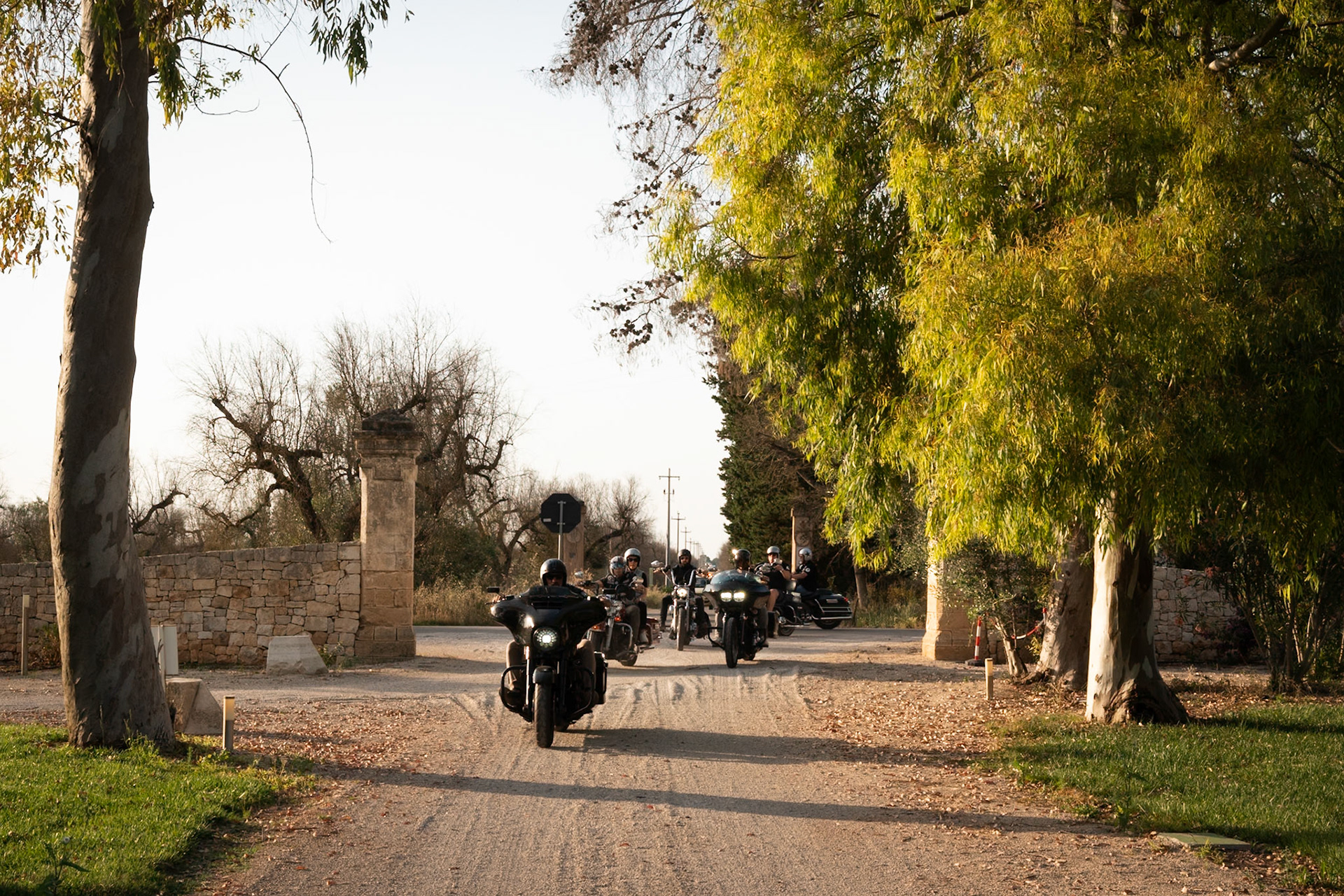
In brief, when riding with them, you feel part of a pack that runs like clockwork. They are long-time brothers who also know each other’s machines and riding styles.
But I’m getting ahead of myself with personal considerations. The point is, during this first meeting with Mauro and Luca, they did not only answer my curiosity but also laid out an entire world for me to get acquainted with. And they did this respecting my role but also being straightforward in keeping a healthy distance from my vivid curiosity. I remember apologising if in my ignorance I was asking stupid questions, and being reminded by the chapter President: “There’s no such thing as an offensive question. There are questions we answer, and questions we don’t”.
The dinner cooked by Johnny, a Prospect, was served and beers were offered. I remember thanking them for their hospitality and for letting me in their Church.
I knew that before me was one of the most interesting communities I’d ever met.